Showing posts with label nature. Show all posts

Friday, 6 September 2013

Botanical Challenge

Every year in September our Botanical Artists Group on Facebook has a 30 days challenge. Normally I can't keep up with it and never end up with 30 paintings/drawings at the end of it. Dianne Sutherland organised this year's challenge. I'll try it too... again...


Because there were a lot of things going on here at my house this week, I already fell a bit behind. So for my first entry I painted not one but two things. A hip of Rosa moyesii 'Geranium' and Acorns from Bertus' harvest. Hopefully I can do two more tomorrow.


Saturday, 23 July 2011

Quail Eggs


I found these little quail eggs in the supermarket yesterday. I couldn't resist.

Watercolour on Lana HP.

Monday, 7 February 2011

Souvenir from Florence

Now that all paintings are finished for the SBA show in London (I framed them yesterday), I wanted to draw something small. And with pencil! After all this time working with the small brushes and watercolours I just had to do a pencil drawing. On my desk I found a small Cypress cone. I found it in Italy last year near the Villa del Trebbio in Tuscany. There were lots of Cypresses on that hill, many of them very old.

 
In a few hours I made this small drawing in my sketchbook. I love drawing pine cones and this one was nice too. I think it's because I can go really black in the shadows. I also love the shape of these cones. Anyway, here it is:
Cypress Cone, Graphite pencil 3,5 x 6 cm

Thursday, 24 June 2010

Wild thing

Grass vetchling ~ Lathyrus nissolia

I finally found some time this week to make a (little bit) larger painting. It's only bigger in paper size, not in subject. This is a Grass Vetchling (almost sounds like some sort of bird). The Latin name is Lathyrus nissolia and its a rare and protected plant in the Netherlands. As you can see the flowers are very similar to other peas. The biggest difference is the foliage. It's a really grassy plant and it doesn't climb like most Lathyrus' do.

It's really thin and there's a lot of white left on the page, as you can see. It was difficult though. The stems are long and thin and I'm not very good at painting straight lines. So I took it really slow. I did manage to give all the lines a shadow part. And for the flowers I got the colour right. The pods were so nice to paint, that was really fun :)

Now I hear you all ask me "Where does this lovely vetchling grow???" Well, I'll tell you.... roadsides, grain fields, woodlands and dykes. Sunny, warm, more or less open places slightly moist, moderately fertile to fertile, slightly acid to often chalky, grassy soil. Plenty of places like that but it's a rare little beauty nonetheless :(

I wish I had this near my house so I could paint a bigger painting with a few sprigs, dancing together. But this must do for now. A lovely elegant wild thing.

Saturday, 12 June 2010

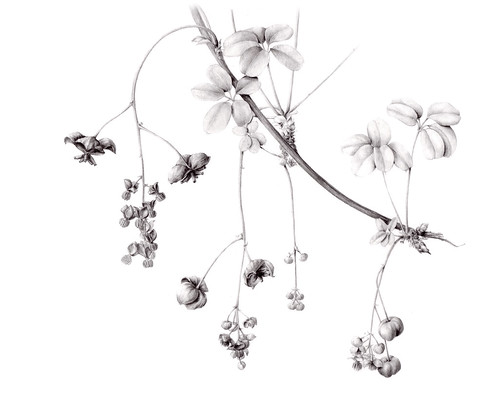
Akebia and a fuzzy practice

My Akebia quinata drawing is still not finished but I'll give you a nice scan of how it looks now. Here it is:


It's so nice to work with graphite again. Now I'll tell you a little about my technique because some people think it is only a very light touch. It is a bit maybe but most important is to use many different kinds of pencils. I use very hard ones (4H) and very soft ones(6B) and some in between of course. One of the most important things is to keep a sharp pencil at all times. So when I draw I have the pencil in my right hand and my manual sharpener in my left. I'm sharpening all the time.
Like in my coloured pencil drawings I layer a lot. In this way I can controle the lights and darks. To make a very smooth looking finish I use a hard pencil or I use a blending stump depending on what effect is needed. Most used tool to get a perfect drawing is my kneadable eraser. I use it all the time, to lift graphite, to add texture, to clean the paper....
Ah, and if you want to make a drawing like this too, be sure to use very smooth paper. I used Bristol for this one but there are other papers that are a bit more creamy and also very smooth.

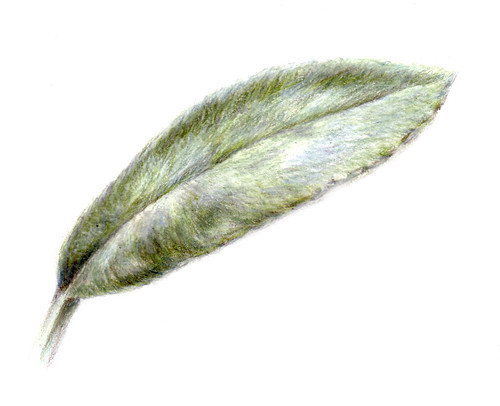
Now, enough about that... Yesterday I had a bit of time to make a fuzzy Stachys leaf.

It's not a great botanical but I wanted to try out a fuzzy looking texture with my coloured pencils. Last year, when I tried it, I totally failed. I think now it's looking better. Not as good as I had in mind, but it's progress.

This afternoon I want to try out a technique I have in my head to make white flowers with coloured pencils. I never tried this technique so I don't know if it will work at all. In my mind it works very well... now let's see if it works in reality ;)

Saturday, 3 April 2010

Playing with greens

Yesterday I was mixing greens. Just experimenting with my browns, yellows, blues and greens. I got some really nice colours but didn't do much with it. Rather stupid not to make something nice with it, I thought. So I started this little memory of a walk through the forest I took last year.

Forest

I used a reference photo too but didn't look too much at it. I think the greens I used are a bit more springtime than they actually were when I took that walk (October).
I never work this "free", it's a bit uncomfortable for me but sometimes it's nice to let yourself go and do something entirely different.

Monday, 22 February 2010

Don't bug me now!

I don't feel like painting crocusses and snowdrops now. I wanted to do something colourful yet not a big project.... A friend of mine sugested to make some insects. I never did that before. Not seriously anyway. So I thought I'd try painting some bugs with watercolours. It didn't work out at all. So, instead of throwing it in the bin I saved it with my coloured pencils. Here's my first little bug:

Chrysolina fastuosa

This is Chrysolina fastuosa. In normal English: the Dead Nettle Leaf Beetle. It's a very common beetle in the Netherlands and oh so pretty. It was hard to draw the metalic shine and the little dimples on the shield. I must add that this image is huge compared to the original drawing. The drawing is made life size (=very small = 1,5 cm = about 0,6") So in this scan it might seem that it has got hairs, in the small drawing it just has little dimples :))

I liked this so much I decided to do another bug today. A bigger one and maybe one of my favourites. Not because it's so beautiful (besides it's hairdo it really isn't that pretty) but because I always look forward to seeing the first in my garden. Always in May.

Cockchafer ~ May Beetle ~ Meikever

It's the May Beetle or Cockchafer (Melolontha melolontha). I made mine 3 cm (a bit over 1 inch) tall (they can be a bit bigger though). Not very happy with the texture on the brown shields. It looks too smooth... and it really is not. Never mind.... I had fun and there is a lot more white paper to be filled with creepy crawlers...

Thursday, 29 October 2009

Fungi family

A few weeks ago I was in the beautiful forest of Roden. There were thousands of mushrooms, so many different kinds and all so pretty. I made some photos so I could maybe draw them at home. Bertus was with me so I couldn't sketch there. I picked this one for a drawing. It's not very detailed. I just don't have enough time and energy to do that. I made it on (bad) paper with coloured pencils and soft pastels.

Fungi

Sunday, 27 September 2009

Quince

Cydonia oblonga sketch

Yesterday Michiel Thomas, a friend I met on Flickr, came to my house to buy one of my drawings. He brought me a large branch from his Quince he has in his garden. On the branch were 3 quinces and I decided to draw one of them. I first made the sketch and today I added the colours. Here it is :)

Quince ~ Cydonia oblonga

Thursday, 27 August 2009

Schiermonnikoog

Last week we returned from our holidays on Schiermonnikoog. It's a small island in the North of the Netherlands between the Northsea and the Waddensea. Since June 2009 the Waddensea is placed on the UNESCO World Heritage List. UNESCO uses several different criteria to assess whether an area merits World Heritage Site status. It deemed the Waddensea to be globally unique in at least three of those criteria.

Het Wad

Of the islands in the Waddensea, Schiermonnikoog holds a very special position. The entire island is a National Park, a special natural region that must be well protected.
Half of the wild plants registered in the Netherlands can be found on this small island.
I love to visit Schiermonnikoog every year. It's peaceful and there's so much nature. And although it's small, it never gets boring. I always take my watercolours with me. This year I wanted to paint some smaller plants on the island.
The first one I painted was the tiny and delicate Seaside Pansy (Viola curtisii).

Seaside Pansy ~ Viola curtisii

The next day I spotted another small plant, becoming more rare very rapidly in my country. It's the Red Bartsia (Odontites vernus subsp. serotinus).

Red Bartsia ~ Rode Ogentroost

Another plant I painted was much more common but very pretty. It's the Selfheal (Prunella vulgaris).

Selfheal ~ Brunel

Finally I painted a plant which I wanted to paint for years now. It's a protected plant and very scarce in the Netherlands. Its the Parnassia palustris or maybe better known as Grass of Parnassus.

Grass of Parnassus

Maybe next year I'll paint some plants from the salt marshes.

Sunday, 28 June 2009

Finished!


It took a while but now the drawing of my Honeybells is more or less finished. This evening I scanned the drawing in 3 parts and I merged them together in Photoshop. The stems need a bit more work but the rest is finished. I'm happy this is done because my next project (also a big one) has started to flower this week.


Saturday, 27 June 2009

Burnet ~ Sanguisorba

Sanguisorba officinalis 'Rock and Roll'

I love Sanguisorba... I have a few different varieties in my garden and they are starting to flower now. I can't get enough of them. The first one is Sanguisorba officinalis 'Rock and Roll' the other one here is Sanguisorba 'Chocolat Tip'.

Sanguisorba 'Chocolat Tip'

Saturday, 20 June 2009

Dark side

Dark Garden

Come over to the dark side... of my garden that is. Thought I'd make a dark version of the garden photos too. It actually is rather fun to do :)

Thanks Heidi for your sweet words! I'm feeling much better because of them :*

Pastel Garden

Pastel Garden

I wasn't feeling that well this week. Actually, I'm not feeling well at all for the last ... months. I had some good periods but overall it has been a bit hard lately. So this week, again, I had a bad week and I was very tired. I wanted to draw, I did draw... but the drawing is not going that well if I'm not feeling okay. When I'm not able to draw I like to play a bit with Photoshop. I decided to make this mosaic. These are all small details from photos I made in my garden.

Sunday, 14 June 2009

Nectaroscurdum siculum

I'm trying to work on a project now. It's a bud of the Nectaroscordum siculum in my garden. The bud is opening and the flowers start to come out and bend down gracefully. It's a beautiful process. I did make a small try (well actually not small, it's 1:1) of a bud first:

First try for my next project

I made drawings of five stages. I placed them next to each other on the Fabriano and now I have to colour them. It takes a long time and I am very busy doing a lot of other things as well.

Nectaroscordum Opening

But I alsmost finished the first part. The open flower (yes I'm working backwards). The flower was still in my garden and the buds were all gone. I made a lot of photos from the buds so I can work from that. But as long as I had the real thing I could use that. So that's why I started with the last one in the row.

Nectaroscordum progress

Tuesday, 2 June 2009

Rosa glauca

The last two days I was working on a drawing of one of my favourite roses. Rosa glauca. It's a botanical rose with small pink flowers. The leaves are spectacular: grey green with a bit of dark red in the veins and stems. In the autumn the rose has a lot of dark red hips. It's wonderful. I made a drawing of the hips two years ago. I will probably do another one this year or next year since I've sold the first.

Rosa glauca

The rose is flowering only for a very short period and I had to work fast for this drawing. This morning yesterday's flower had dropped it's petals. I'm happy with the flower and I think the pink resembles the true colour very well. Also the buds and the stem (or branch) are very good I think. The leaves however are a bit of a problem. I don't like doing leaves and the colour of these leaves is very difficult. I managed to draw two leaves and I hope the pink of the flower and the red of the branch will distract the attention from the leaves a bit.

Oh, and about the rose... it's called Rosa glauca, which means Red-leaved rose. The front of the leaf is grey- green but the backside of the leaf is a bit reddish. The veins are red too. It is a species of rose native to the mountains of central and southern Europe.

Thursday, 28 May 2009

Thorns

This is the last drawing I'll show you of my botanical drawing course with Valerie Oxley, three weeks ago. Valerie told us a few remarkable things about the difference between thorns, prickles and spines. She wanted us to make sketches of them. She brought all sorts of painful subjects. Like roses (of course) thistles and Pyracantha (Firethorn). I made a few sketches but I didn't want to make one page with the different branches and leaves. I wanted to end the course in colour and decided to make a coloured pencil drawing of a Berberis twig. I finished the drawing when I got home. I really like this one. The sharp pointy thorns and the beautiful colours were a lot of fun to draw.

Berberis thunbergii 'Atropurpurea'

The drawing I will not show you is the drawing I made of a Stachys leaf. We learned a few things about painting and drawing hairy and silver coloured leaves. The drawing wasn't very good. Maybe with a bit more experimenting with the different techniques I will come up with a good result but this leaf was a bad experience. The thing I learned that day was that I don't like to draw hairy and silver coloured leaves.

Anyway.... This course was a lot of fun. I met some very nice people again and Valerie Oxley taught me some very good things. I hope you enjoyed this too :)

Monday, 18 May 2009

A leaf

I promissed to show you some more results from my botanical drawing course. On Tuesday we did a practice with leaves. How to draw and paint twisted, folded and turned leaves. Most of the ladies in the course made a drawing/painting of a hosta or Persicaria leaf. I was the only one drawing this leaf. The woman who brought this leaf to the course told me it was a Helianthus leaf. But I have big doubts about that. But it doesn't matter very much. It's only a practice after all.

Greens are difficult and leaves can be so very, very hard to draw well. Actually I admire artists that paint a lot of foliage. To paint one or two beautiful leaves is great of course. But to paint a whole bunch of them and do them perfectly.... sigh..... I just don't have the patience to do that.

Helianthus (?) leaf

Anyway... Here's the drawing. Coloured pencil again. And I must say that I'm pretty pleased with it. The fade-away distant colours just happened. I didn't think too much about that.

I had some trouble with the pencils though. The tutor, Valerie Oxley, brought some pencils to the course. I could use them if I wanted to. A nice way to try out some other brands. I tried some greens from the Derwent Coloursoft series. I wish I hadn't. I picked a beautiful Dark Green colour. A super colour for the shadow parts in this leaf. But when I burnished some of it with my white pencil the green turned into a viridian/ cobalt blue greenish colour. Very bright. I tried to get it all out of the leaf, but as you can see... here and there I couldn't. Never mind. It was a good practice and now I'm very sure I don't like the Derwent coloursoft pencils.

Saturday, 16 May 2009

Yellow

Last week I joined a 5 day botanical drawing course. My tutor that week was the wonderful Valerie Oxley. The Dutch Society of Botanical Artists invited her over for this masterclass. Every day we practiced a different subject of botanical painting and drawing.

We started on Monday with yellow flowers. Yellow flowers artists often avoid because they are a bit tricky. Not me... I avoided yellow flowers just because I don't like them. But that day there was no excuse, we had to do a yellow flower. A tulip.
The first drawing we did was done by putting in the shadows first and then the colours. (I forgot to tell you that there were people working with watercolour and also some people worked with coloured pencils. I was very happy I wasn't the only one using the pencils) The second drawing was the other way around. You can see here the first drawing on the left and the second drawing on the right.

Yellow Tulips

In the first drawing I used greys for the shadow parts. In the second drawing I used a bit of light violet and warm grey in the darker parts. As always with light coloured flowers (or any other subject with a light colour) I concluded that it's better to work in the shadows later because you have more controle over the colours.

I had fun doing this practice although I still don't like yellow flowers. And I also still believe that yellow tulips is the closest you can get to a plastic-flower-look. Later this week I'll post some more drawings and sketches I made during this course.

Wednesday, 1 April 2009

Romantic

Prunus subhirtella 'Autumnalis'

I'm feeling a bit romantic every time I see my Prunus blossom in my garden. I so very much love this little tree.... I made a drawing of it once and a watercolour too (blogged that here). Maybe it's because I just can't get enough of it.
Oh... btw... this is Prunus subhirtella 'Autumnalis' again :)