Showing posts with label drawing. Show all posts

Wednesday, 21 January 2015

Ink Flow

I've had a tennisarm for quite a while and it's driving me crazy. Yup, that's one of the reasons why I didn't post something new. Although it's getting better everyday I still can't use it well for painting and drawing like I want to. I have a pile of work waiting for me with a deadline so it's hard sometimes not to get too frustrated. To take my mind of this project waiting for me to continue (and finish in time!) I had to do something to keep me busy.

A friend of mine advised me to take my new ink and my dipping pen and start making quick sketches. No time wasting on observing every little detail, making numerous studies before I really started... no, nothing of that this time. Just sit and sketch with pen and ink.

The first drawing wasn't free at all. I did a sketch first and traced the pencil lines with the dipping pen. The result was nice but not much more than that:

Pyrola rotundifolia (Round-Leaved Wintergreen)


The drawings after this one were much better. Now I must say that I have done this in the past but had totally lost it over the last ten years or so. It's such a relief to let myself go again and not to worry about the mistakes. I HAVE to accept that mistakes will happen and that I can't undo them. I always enjoy much more the sketchbooks and the direct sketches and studies of other artists than their "finished" work. It sounds silly but it never occurred to me that my own sketches might have that same kind of charm.

So for these drawings, I'll show you three here, I made the drawing with my dipping pen (a Speedball pen with Hunt nib 22, extra fine) and three kinds of ink: J. Herbin 'Cacao du Brésil' and 'Vert Olive' and Winsor & Newton Matt Black Calligraphy Ink. Also did wet-in-wet washes with those inks for shape and depth.

Rose hip

Dried Beech leaves in winter

Iris siberica seedpods
Winter subjects with dried old dead stuff is perfect for doing these sketches. So for this the timing is good. Although I really rather have my good arm back and draw for the next exhibition...

Sunday, 23 November 2014

I like big bulbs and I can not lie

Next year the society of Dutch botanical artists will get the opportunity to show their work in the Shirley Sherwood gallery in Kew Gardens, London. The mission is to show lots of paintings and drawings of bulb flowers. Naturally it will have the tulips. I guess there is no avoiding those. But I definitely didn't want to portrait tulips, Narcissus, crocuses or hyacinths. There are so many flowering bulbs worth looking at and many much more appealing than the regular narcissus and tulip. So I picked two of my favourite bulbs. Large and gorgeous. First Fritillaria persica:


I did it in coloured pencil and I love how this flower moves like a dancer, swaying her hips.

The second one is Galtonia viridiflora. Not a very common bulb but I have had them in my garden for years and just love the green/cream coloured elegant bells. This one I started in watercolour but half way decided it would look better in coloured pencil.


Hope they both will be admitted for the exhibition in London and that many of you will be able to visit the exhibition. Of course I'll post the announcement of the opening and exact dates here and on Facebook. Until then I'll get started with my next (fun) project. More about that in future posts too ;)

Wednesday, 27 August 2014

Arum italicum - WIP


One of my dear friends had an accident some time ago and still is in a bad shape. She feels depressed about it all. She lives in England so I can't go and visit her or help her out but I decided to make her a drawing. Something to look at and to know people think about her and care. My drawings are all a small part of me and giving it to someone is the most personal gift possible. I think all artists will agree with me on that.

I have now lots of seedheads of Arum italicum in my garden. They start with green, shiny berries which start (at the top) to turn into bright orange ones. From a distance they look like orange gnome hats in the shadow under the trees. The common name of this plant is Lords-and-Ladies. A really wonderful name, like so many other English plant names.
They make me happy. I really don't like orange flowers and am not crazy about orange berries either but somehow these bright drumsticks make me smile. Perhaps it is that gnome-thing or maybe it's the memory of the sweet Flower Fairies paintings by Cicely M. Barker.


They just have something magical about them. So I picked a few from the garden and started to draw. It's not finished yet. I'm currently working on another big project as well so this takes a bit longer. My son told me I should do it in coloured pencil because it has been too long since I did a coloured pencil drawing. Who am I to disobey. Here's what I did so far. I'll post the finished one soon.


.

Monday, 28 October 2013

I Conquered the Conkers


Or "Bonkers for Conkers" could have been great title too I guess. Here it is, at last... the composition I made with the Horse Chestnuts and some twigs and dried leaves from the tree. It's all in coloured pencil and a lot of fun to do. I'm very happy though that I now can do something else again... This weekend I found my vellum. So maybe.....

Sunday, 6 October 2013

More Chestnuts

Horse Chestnuts that is. They never bore and they are all so different. I just had to make a series of them. I might do one or two more but thought I'd share what I've done so far. All in coloured pencil.


Sunday, 29 September 2013

Conker


So... not reaching the target of 30 this year. Last year it was my arm and now the cold spoiled it. Oh well, I'll just continue with a few, just for fun. Here's a conker in coloured pencil. There might be more of them since there are still many on the trees. And they are loads of fun to draw.

Friday, 27 September 2013

Pomegranate


I will not get all 30 drawings done for the challenge. I got a cold and felt bad the last couple of days. I'll continue though for fun but 30 is no longer my target. It doesn't matter so much. I had fun the first weeks.

Last days I "painted" a pomegranate in coloured pencil. My Italian friend gave me two nice red ones and I had them still in a bowl waiting to be eaten. But before eating them I wanted to paint or draw them. So, with a runny nose and burning eyes I did just that. Time to eat it now and get better ;)


Sunday, 22 September 2013

Learning by Teaching

Today I posted this on my wall:
Last week I had a new student here in my studio. It was great. Going back to the basics and telling her lots about graphite techniques and even more about form and shading. Explaining why you put shadows here and not there, why you should do this and not do that.... wow....
All these things I do so automatically and now I need to explain my every action and decision.
It's not easy when someone asks you so many elementary questions. A wise man told me that it's like teaching a foreigner about your own language without being too familiar with all the grammar rules.

Perhaps it was me being the student, not her...

I needed to let it all sink in I guess before I could come to this conclusion. If you can call this a conclusion. It doesn't matter what it is. It was a good thing and that's what matters.  

So talking about this session with my new student, I thought it would be nice if I could show her how you can use atmospheric perspective in a drawing to create a sense of depth. For making this example I had cut off a twig of a Snowberry shrub near our house. I personally don't like them but just like the Cherry Laurel, it looks fine in black and white ;)

I first made a line drawing (my number 12 drawing for the challenge). 


So I created that same twig (using the line drawing as a base) for the tonal study (the no.13), using a bit of atmospheric (aerial) perspective this time.

Sneeuwbes

The photos here didn't turn out so well. I need to try and make better ones. But you get the idea... hope my student does too ;)

Tuesday, 17 September 2013

Cherry Laurel Update


I managed to finish the Cherry Laurel today. So here it is. No.10 and 11 of the 30 day challenge.

Monday, 16 September 2013

Graphite Warm-Up

On Wednesday I'll be welcoming a new student in my studio. I haven't met her yet but she sent me some photos of her work. What I saw was very promising. We agreed to go back to basics and start with graphite pencils. She already made some pencil work but it looks a bit rough and unfinished. So we'll dive into the graphite techniques.
I haven't worked in graphite for quite some time. And if you have to start after a long break you feel rusty and a bit clumsy. Like a machine that needs to be oiled and warmed up before working well again. Well, that's how it is for me anyway. And I know this. So, to prevent myself from drawing like a beginner next Wednesday, I ordered myself to a warm-up. And since I'm also working on this 30 day challenge on Facebook, I thought to combine the two. So here they are...

First a leaf from some sort of crab-apple in our street. No idea what kind of Malus it is but I always like the leaves and how they curve. It's my first one and I did feel very rusty. I think it shows too and I made a few stupid mistakes (like working too fast and putting in the veins with an embossing tool) but the leaf itself and the lines worked nicely.


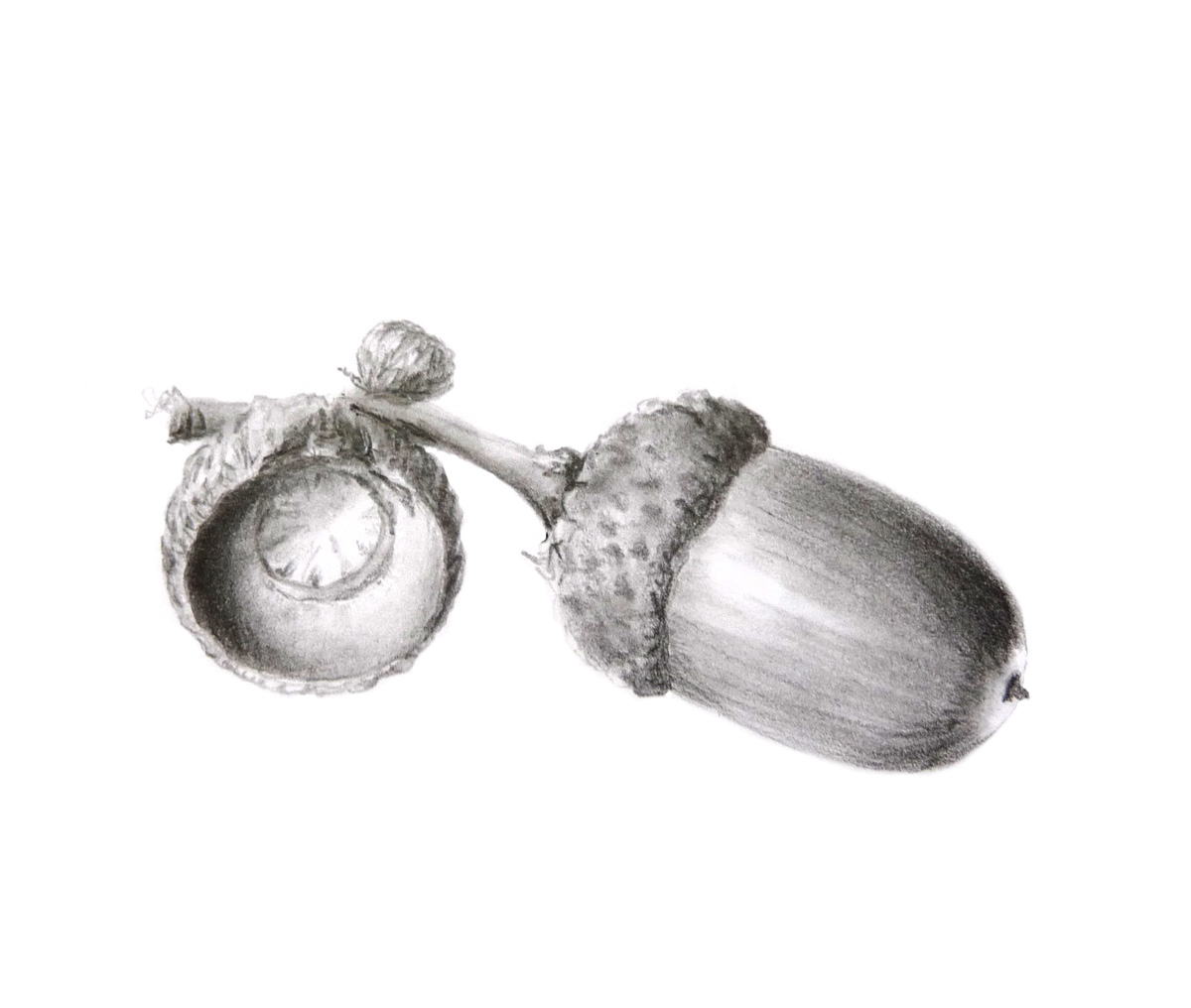
Like I said, I knew this would happen. It always does. So next I tried to work slower but it was a small drawing so it went rather quick anyway. A nice Acorn. I love to draw and paint acorns. No idea why but it's just one of my favourite subjects. It went rather well and although it could have been more detailed and smoother I was happy with it.


Today I started a project that will take at least two days. I think the 30 day challenge should be all 1 day pieces but I divided the drawing in two parts. Today I did the fruits, tomorrow I'll do the leaves. I cut a twig of a Cherry Laurel (Prunus laurocerasus). I really hate that shrub and never thought I would draw it but in graphite everything looks good. I guess it's like photography. If all else fails, do it in Black and White ;)


More later.


Wednesday, 3 October 2012

Sterappel


It has been a while again since my last post. Partially because I haven't painted much since my last blog. At least, not very botanical anyway. BUT now I have finished something that's worth sharing.
Some weeks ago I went to a nursery ("De Vrolijke Noot") of fruit trees and bushes. The owner gave me a cutting from one of his apple trees. The apple is named "Sterappel". That means "Star Apple" if you translate it. Stars, because the apple has very clear bright lenticels on the very dark red skin.
I posted the end result on Flickr and Facebook already and was very happy when Rosie Sanders complimented me on the painting. Rosie made a few years ago the famous Apple Book. She knows a lot about the different varieties and asked me what kind this is. I didn't know the English name of it. I only know the German, French and Dutch name. Later Rosie sent me a bit of more information about the apple: "I've looked it up in the National Apple Register and it seems that it is Reinette Rouge ÉtoilĂ©e, first described in 1830, provenance Belgium or the Netherlands. Has lots of synonyms including Sterappel and Sternrenette. Interesting!". 
What I do know is that this used to be a very popular apple in the Netherlands but has become very rare now. The problem with these apples is that it falls too early from the tree. Often it hasn't got the deep red colour yet when it hits the ground. To give the apples the wonderful, dark colour the apples were placed on straw between the trees to get more sunlight and the cold from the nights. To save the apples from dehydration the apples had to be wetted. Also to get an even red colour the apples had to be turned after a while. Very intensive work if you have a large orchard.

Now, about the painting... I used for this Arches HP (I was out of Fabriano) and painted it first in watercolour. Using masking fluid to save the "stars". After that I put on layers of coloured pencil. And although I did get a very nice and rich dark red colour with the watercolour, the coloured pencils made it even more alive. I really loved this way of working and I think I'll use this technique more. The only thing I don't like is that the watercolours roughen the paper surface. I will have to find a cure for that. More experimenting is needed. 

The painting (only watercolour) with the masking fluid to protect the "stars".

Oh, and remember that an apple a day keeps the doctor away.... right? Not really.... I went to the doctor last week and it turned out that I have a very sportive right arm: a golfer's and tennis elbow (bilateral epicondylitis). With painkillers it's possible to work for about an hour a day. So the next project will take some time to get finished. But I promise, it will be a bit different ;)

Thursday, 12 April 2012

A Bulb Drawing and Some News

A lot has happened lately. Really... a lot. I'm happy to say it's all quite positive. I finished a bulb drawing today, an interview about me and my art was published in Noorderland magazine, I finally built my new website (and it works!!!!) and I'll be teaching in a new course about drawing botanical art with coloured pencils. It's a lot.

First of all, let me show you the drawing. It's done in coloured pencil and it's a Crocosmia 'Lucifer' bulb which I pulled out of my garden this week. The contrast of the died leaves and the new, toxic green sprout is so nice. Well, I like it anyway :P

It wasn't an easy thing to draw in coloured pencil. I think it would have been more easy if I had used only graphite pencils. The hardest part of it was the fibre, straw-like part above the bulb and between the two dead leaves. White thin sprigs. Many of them too... Ah well, I managed it somehow and I'm rather pleased with the result too. That doesn't happen so often.

So... then there's the article, 6 full pages in a very nice magazine, Noorderland. A large interview, a lot of my drawings (nicely printed) and nice photos of stuff in my studio and also of me. So if you live in the Netherlands or there about, have a look.


Now, because I was going to feature in this big article I really had to update my website. And because I'm such a stubborn person that always knows best and never likes prefab website designs, I wanted to build it myself. I'm happy now with the style and all I need now is to build a little e-store to sell cards, prints and other stuff. So if you haven't done it already, please have a look at it. Some feedback is always nice ;)

www.sigridfrensen.com
Finally the 6-day-drawing-course. That will be (I really hope I get enough students for this) next June in the botanical garden "De Kruidhof" in Buitenpost. On my website is a folder with more info. It will be six days in three weeks time. I'm looking forward to it... sitting in the gardens there, peacefully struggling with all the plant material, trying hard to get it all down on paper.... Aaaaah..... splendid!


Sunday, 2 October 2011

Rose Hips in Coloured Pencil

TUTORIAL

This is a long tutorial, many steps but since I know many of you have difficulty to understand the process, I thought it's better to share every little step I took in creating this drawing. Enjoy :)

Materials

Every twig with rose hips is different of course so only use this list of colours as a guide. Of course you can use my list but I strongly suggest you have a good look at your own rose hips to see what colours will be best for you.
This list is not complete. I used a lot of different other colours for smaller details. It is wise to get as much different colours so you have large range to pick from.

  • Coloured Pencils:

Faber-Castell
234 Cold Grey VI
235 Cold Grey V
141 Delft Blue
278 Chrome Oxide Green
175 Dark Sepia
126 Permanent Carmine
223 Deep Red
121 Pale Geranium Lake
113 Light Orange
171 Light Green
168 Earth Green Yellowish

Prismacolor
1067 Cool Grey 90%
996 Grape
1095 Black Raspberry
925 Crimson Lake
923 Scarlet Lake
937 Tuscan Red
917 Sunburst Yellow
940 Sand
938 White
1026 Greyed Lavender
1087 Powder Blue

Yes, I use a lot of colours, I know :P
  • Graphite pencils: HB, B, 2H, and the hardest you can get (I have 10H)
  • Tracing paper
  • Lyra Splender Blender (or another colourless pencil blender)
  • Electric Eraser (like Sakura)
  • kneadable eraser
  • Embossing stylus, the thinnest you can get with a rounded tip. I use the Pergamano 0,5 10031.
  • Low tack Frisket Film (you just need a small piece of that)
  • Sketchbook/Sketching paper
  • A sheet of HP watercolour paper. I use Fabriano 5. Any brand is good as long as it’s white and HP (which is very smooth). Don’t use Bristol because that will smudge too fast.
  • A very good sharpener for your pencils.
  • Fine sandpaper for sharpening the pencils.
  • Eraser shield is optional

Step 1: Line Drawing


First of all you make a drawing of the twig in your sketchbook. Once you’re happy with it, make sure to erase all the sketch lines and mistakes, leaving a clean line drawing.
Now you trace this and transfer it on to your watercolour paper. Be very careful not to press your pencil too hard in the paper (this is very important!). Go over the graphite transfer lines with a very hard and pointed pencil (and don’t press too hard!!!). Draw very light, just enough to see the lines. Use your kneadable eraser to clean the paper, removing all the graphite powder from the tracing.

Step 2: White highlights


Before you start colouring anything you have to put the highlights in. I mean the very, very lightest parts. For now we'll call it white. The larger white reflections you can do with a white coloured pencil. I prefer to use my PC 938 because it is more "fat" than the Faber-Castell white. The tiny little spots of white or small light coloured light you want to save can be marked by using the embossing stylus. You press a little dimple in the paper so the next layers of colours won't reach that paper and stay white.

Step 3: Tonal Base


Now take the Faber-Castell greys and start putting in the shadows. Don’t press too hard. Make your shadows darker by taking a darker grey, not by pressing harder. Work gentle with small movements. Make small overlapping ellipses. Always use a sharp point, so often use your sharpener or sandpaper. Don’t push the greys too far into your drawing. Be sure to soften the edges to the white so you get a nice fade.

Step 4: Darkest shadow colours

Now squint your eyes and try to see only colours. What is the basic red, what is the colour in the darkest parts, what colours do you detect in the lighter parts. The parts that aren’t ripened entirely might be more green or orange. Make some colour studies on a scrap piece of paper. Layer some colours to see the effect.
Now start with the darkest colour for the shadows. Don’t pick a darker version of the base colour, don’t pick dark red. Pick something that glows through the red. I used Faber-Castell (FC) 141 Delft Blue and FC 278 Chrome Oxide Green. Again, add a very thin layer and don’t press too hard. Always a sharp point and gentle, gentle, gentle...

Step 5: First Colour


Take the colour you see all over the hips (the main colour). For me it was FC 126 Permanent Carmine. Put a soft layer of this red all over the hips where you can see that colour. Of course not on the white parts and not in the parts where it has a totally different colour.
As you can see I did the same with the twig, using FC 278 Chrome Oxide Green and FC 175 Dark Sepia in the shadows and FC 171 Light Green as the main colour.


Step 6: Deepen the colours


Have a look at the hips and look what colours you see “hidden” in the main red colour. I can see some orange glowing through the red in the lighter parts. Other parts have some blueish purple, I also see some browner reds. Put the right colour in those parts. In the image you can see I’ve added the FC 113 Light Orange. Still you’re not pressing the layers. Don’t forget to sharpen your pencils and work with small gentle movements. Don’t concentrate on details yet.

Step 7: Deepen the shadows


This is when I will make the shadows darker. I used a bit more FC 278 Chrome Oxide Green and Prismacolor (PC) 1095 Black Raspberry. I go really dark in the shadows and almost black where there are overlaps. Be sure you don’t go too dark near the edges.

Step 8: Deepen Reds


Take all your reds and layer your reds until you are happy with the colour. Try to use the FC pencils first and the PC last. When you feel good about it you can start using a bit more pressure to blend the colours together. Also put a layer of red over the shadows.

Step 9: Going Back To The Shadows


You might notice that the shadows got a bit weakened by the reds. So go back there and add again more colour. I used more PC 1095 Black Raspberry and in some parts a bit of FC 175 Dark Sepia and also PC 996 Grape.
The shadows in the rose hips closest to the viewer are darker. This is where I used more Black Raspberry. The hips further away have more Grape. This because it’s a cooler and a bit lighter colour. It’s a bit of aerial perspective.

Step 10: Blend the Reds


Now start blending all red layers with red coloured pencils. What I mean by that is that now you can start using more pressure to get a paint like effect and mix all the colours of the previous layers together. I love to use my Prismacolor pencils for this because the colours are just a bit deeper and stronger than the Faber-Castell pencils.
Be very careful not to go in the white parts. And even in this stage... keep your points sharp!

Step 11: The highlights


Now it is time to add the highlights. I used the PC 938 White. Be very careful to work from the white part to the red colour. Clean your pencil point every time it has been into the red and you want to go back into the white again. I also use the white with some pressure over the reds around the highlights as well.

Step 12: Reflected Light


After the highlights I take my PC Powder blue or a light cool grey or a greyed Lavender, what ever looks best, and add the reflected light in the shadows and around the shadow edge. Use a very sharp point and do this carefully. You want a sharp edge.
Now use the blender pencil all over the hips (but avoiding the white). If you feel the colours turned a bit dull you can lift it by adding a bit of red over it.

Step 13: Details

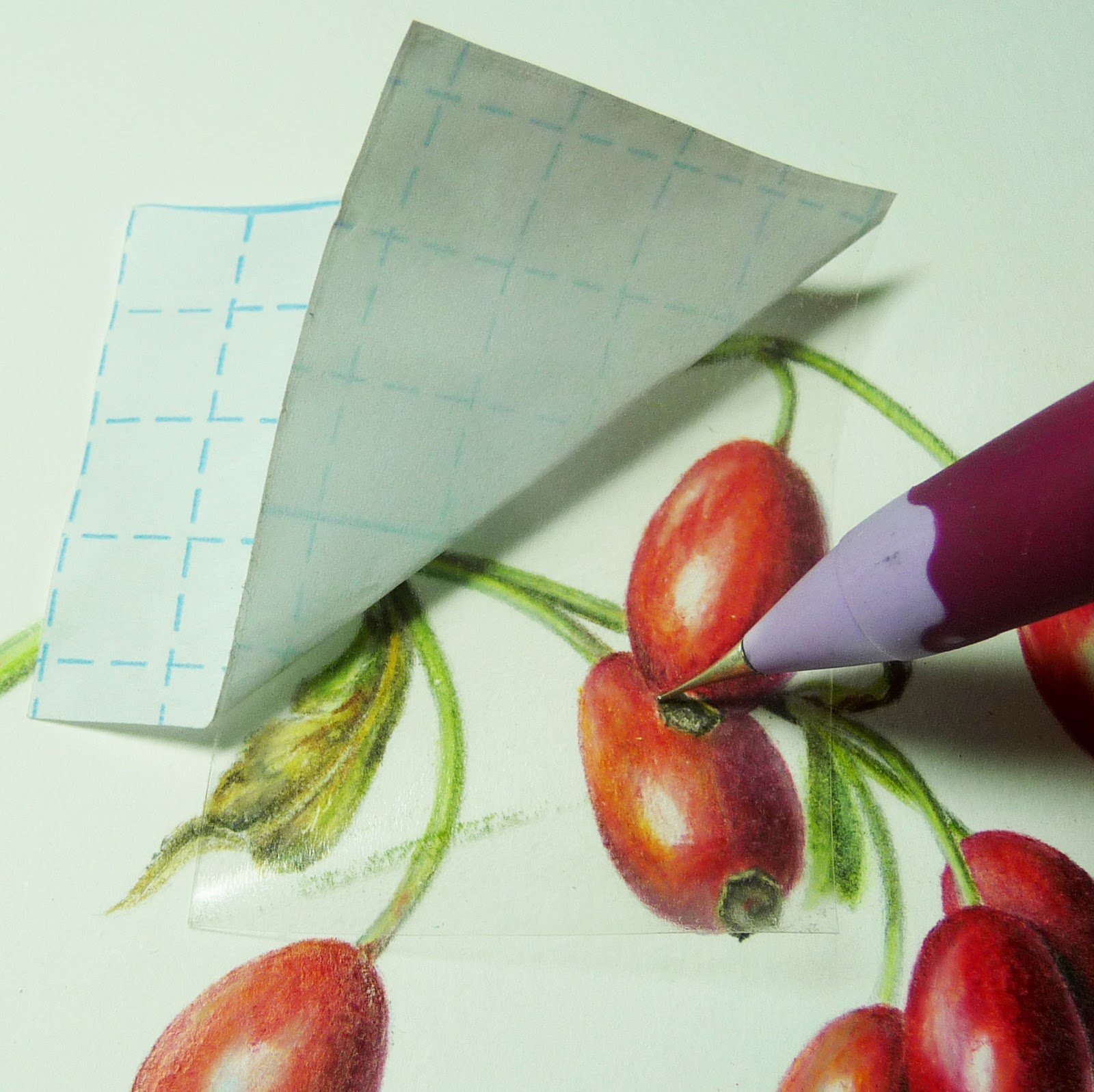
Finally you can concentrate on the details. You will probably see that some tiny embossed highlight points are gone or nearly gone. You can still see the tiny dents but the blending might have pushed some colour in. You can lift this by using some low tack Frisket film and your embossing tool. See the photos to see the magic happen.


You can use the Frisket film or your electric eraser to lift colour from the parts where “nasty brown bits” are. Small damages, beasty bites and things like that. These not so perfect parts give a lot of charm to the hips and make them more alive.


Peel some of the paper off the film and lay it over the part where you need to lift the colour. DON’T stick the film on the drawing!!!!


Take your stylus and make a tiny dot where the highlight should have been. You can also add a few new highlights like this if you feel it needs more white spots or lines.

Step 14: Sharpening the Lines

The drawing will look best if your lines are clean and sharp. On the other hand you don’t want it to be too sharp and crisp.
Most important is to have very, very sharp points on your pencils. It helps if you use a harder pencil than the Prismacolor pencils. Faber-Castell is hard but there is also the Prismacolor Verithin range. Very hard and very useful. The only problem is that you can only get it in the US.

Work from the “inside” of the drawing (see photo).


Finally you can use the hardest graphite pencil you can get (I have a 10H) and make a crisp line on the edge of your drawing. The reason why you need a hard pencil for this is that it gives a very thin line (use the sandpaper to make it dangerously sharp) but it hardly gives you a grey line.

Don’t overdo this crisp lining. Use it on tiny details, thin lines and very carefully along the stalks and stems. If you do too much or use a line that is too dark (too soft pencil) it will look artificial.


At the end, clean the paper with the kneadable eraser. Large boo-boos you can remove with the electric eraser (use an eraser shield if you need to do that near the drawing).


Finally

I hope you enjoyed this tutorial and that it all made sense, helped you and made you (more) enthusiastic about making botanical art with coloured pencils.

.

Monday, 7 February 2011

Souvenir from Florence

Now that all paintings are finished for the SBA show in London (I framed them yesterday), I wanted to draw something small. And with pencil! After all this time working with the small brushes and watercolours I just had to do a pencil drawing. On my desk I found a small Cypress cone. I found it in Italy last year near the Villa del Trebbio in Tuscany. There were lots of Cypresses on that hill, many of them very old.

 
In a few hours I made this small drawing in my sketchbook. I love drawing pine cones and this one was nice too. I think it's because I can go really black in the shadows. I also love the shape of these cones. Anyway, here it is:
Cypress Cone, Graphite pencil 3,5 x 6 cm